See more. Measure more. Understand more: New ZEISS ARAMIS 12M dual-sensor system at Neue Materialien Fürth GmbH
- /
- / news
Expanded capabilities in optical 3D metrology
With the new ZEISS ARAMIS 12M dual-sensor system, Neue Materialien Fürth GmbH is expanding its capabilities in optical 3D metrology based on digital image correlation (DIC). The system combines two high-resolution optical 3D sensors, allowing measurement data from different perspectives to be integrated into a coupled 180° strain analysis.
Particularly in the determination of material parameters for metal forming technology, this technology opens up new possibilities for more comprehensively acquisition and analyzing the strains and deformations of test specimens.
Two sensors for a combined 180° strain analysis
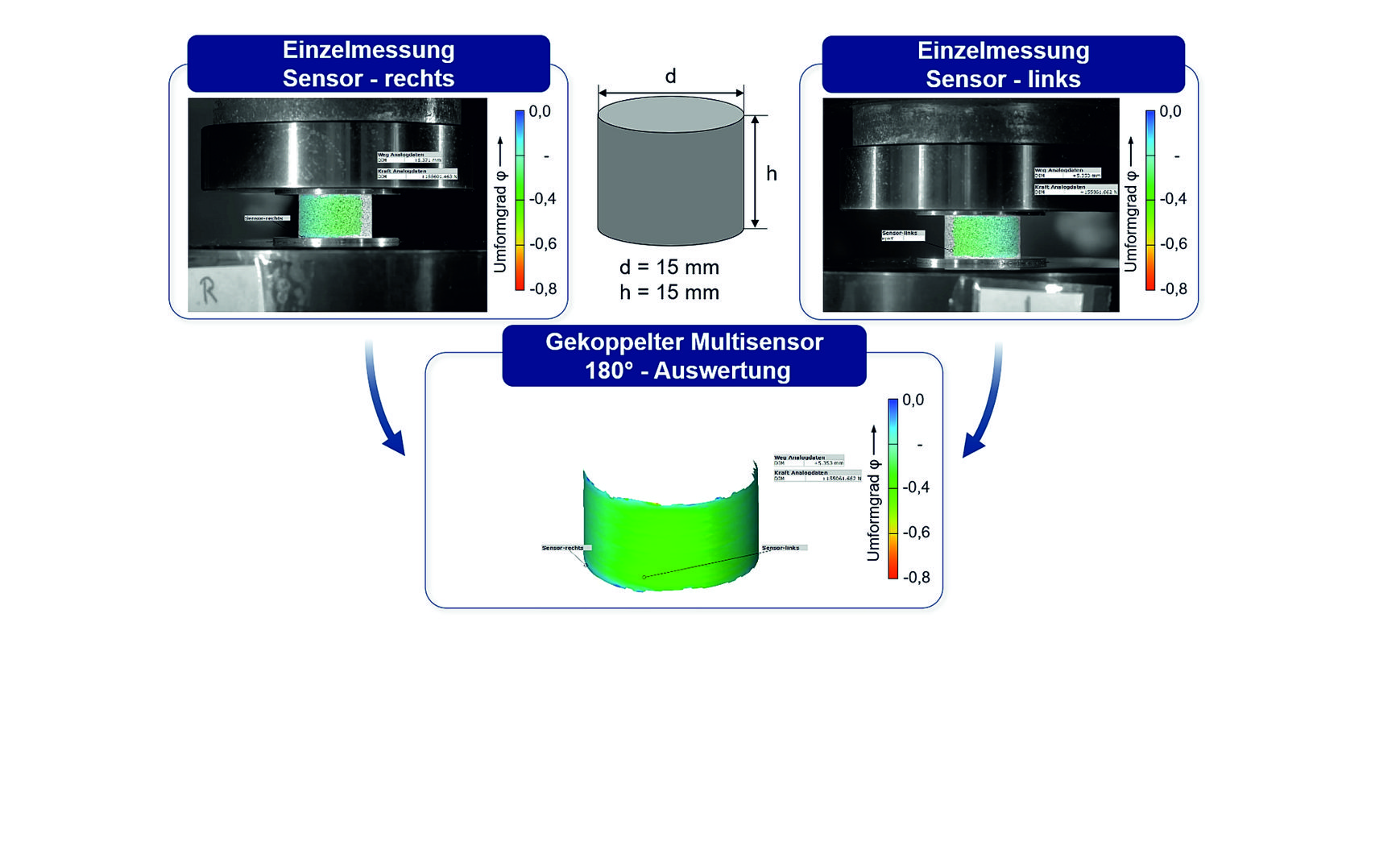
By coupling the two ARAMIS sensors, the captured measurement data can be integrated into a combined 180° strain analysis. This provides an expanded field of view for analysis, enabling the observation of strain distributions and deformation processes across a larger area of the specimen.
Key advantages include:
- Combined data analysis: Integration of measurement data from both sensors into a coupled analysis.
- Expanded measurement range: Capture of a larger area of the specimen surface from multiple perspectives.
- Detailed strain analysis: Visualization and investigation of local strains and deformations.
- More comprehensive test evaluation: Additional insights into the mechanical behavior of specimens under load.
Application in determining material parameters for metal forming technology
One example of its application is the layer compression test, which examines the flow behavior of thin sheet metal under compressive loading. For this purpose, several discs of the respective sheet material are stacked on top of one another and then subjected to uniaxial compression.
Optical measurement is performed from two perspectives: one aligned with the rolling direction and the other at a 90° angle to it. The ZEISS ARAMIS 12M dual-sensor system makes it possible to combine the measurement data from both sensors into a synchronized analysis.
The interaction between the two sensors and the resulting analysis are demonstrated in the accompanying video, using a cylinder compression test as an example.
Innovative measurement technology for detailed material analysis
With the ZEISS ARAMIS 12M dual-sensor system, Neue Materialien Fürth GmbH strengthens and expands its capabilities for the optical acquisition and analysis of mechanical deformation processes.
Greater measurement range, more information, and more meaningful results.
Wie entsteht bei einem Zylinderstauchversuch aus zwei einzelnen Sensoransichten eine gemeinsame 180°-Auswertung?
Don't miss out!
Receive event announcements and the latest news straight to your inbox.

