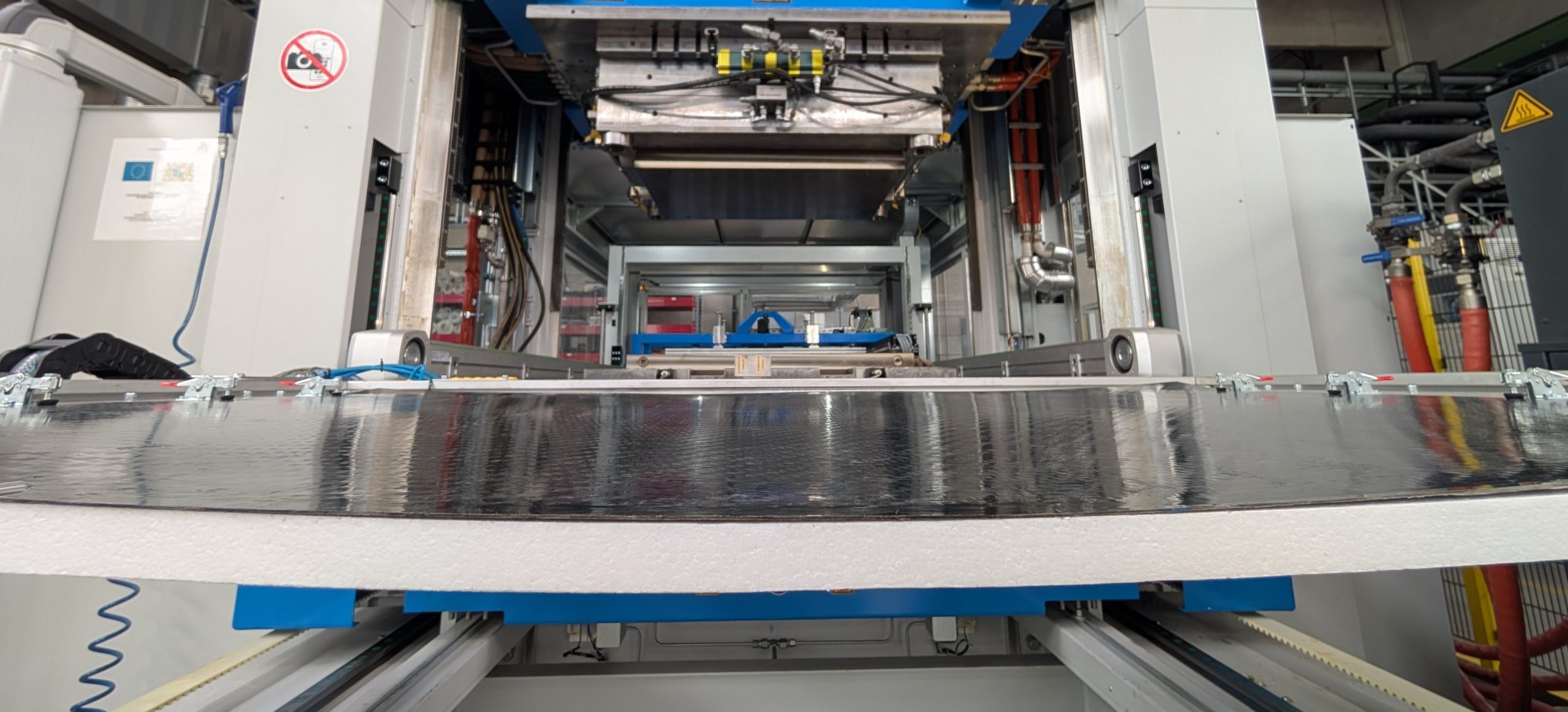
NMFs precision thermoforming station “LiSA” is being expanded to serve as a development platform for large-area, recyclable thermoplastic sandwich composites with honeycomb and particle foam cores. With enlarged infrared emitter arrays, intelligent individual emitter control and an enhanced three-layer handling system, new testing possibilities are being created for functionally integrated lightweight components across various industries.
Lightweight construction with a focus on circularity
The overarching target is to construct outer and core layers from materials that are, as far as possible, made of the same thermoplastic matrix or are polymer-compatible, and to join them thermally. Mono-matrix concepts facilitate material recycling and support closed loop material cycles. At the same time, the specific advantages of different core concepts can be utilised: honeycomb cores enable high stiffness with low weight, while particle foam cores offer additional potential for energy absorption, acoustics, thermal insulation and functional integration.
Larger components with precise heating
With this expansion, the IR emitter arrays are increased to a heating area of 1500 × 1000 mm. This opens up new possibilities for large-format components and panels, for example in the automotive industry, the caravanning sector, for rail and commercial vehicles, in the construction industry or in logistics. A key feature is the precise individual emitter control for the separate regulation of the upper and lower emitter arrays. This allows temperature distributions to be homogenised – particularly for thin-walled cover layers and large component surfaces – and specifically adapted to different material combinations, layer structures and geometries.
Multi-layer and functional structures
In addition, the handling system is being expanded, too. It enables the reliable handling, heating and forming of three-layer and multi-layer structures. Face and core layers can be tensioned in a controlled manner, joined together at different levels and precisely adjusted during the joining process. Controlled post-sliding of the individual layers helps to prevent stresses, creasing and local bonding defects. In addition to thermoplastic sandwich composites with honeycomb or particle foam cores, complex layer structures can also be investigated in future. These include, in addition to organic sheets and tapes, oriented films, deep-drawing films, decorative films, non-wovens, self-reinforced laminates and functional layers such as fire-retardant layers, conductor tracks, heating structures or sensor systems. The system thus combines structure, surface and function in an integrated manufacturing process.
Efficient process routes for thermoplastic sandwich composites
This expansion enables several process routes: Firstly, thermoplastic semi-finished products can be heated quickly and efficiently and, together with core layers of uniform thickness, formed and joined to create 2D, 2.5D or 3D sandwich components. For the particle foam process, a mobile blowing unit is also integrated. This allows pre-foamed thermoplastic beads to be inserted directly between the face sheets during processing and welded together to form a solid core of variable thickness. For this novel process route, pre-treated foam beads are welded under heat and pressure without resorting to energy-intensive superheated steam processes. This is of particular interest for thin-walled sandwich composites, as thermoplastic face layers, on the one hand, provide a certain amount of heat, while, on the other hand, they hinder heat transfer into the core area. With skilfully controlled thermal conditions within the mould, synergy effects can be achieved and energy-efficient process control can be pursued.

